Tuesday, July 10, 2012
A Stashing I Will Go!
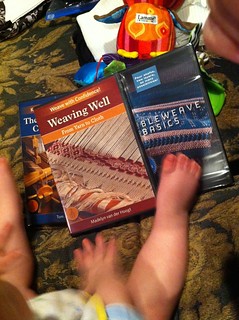
Last week, I added to my DVD collection.


New DVDs

That's The Loom Owners Companion (Tom Knisely), Weaving Well (Madelyn van der Hoogt), and Doubleweave Basics (Jennifer Moore).

The munchkin declared them great teething toys!

Now if I can just find time to watch them.
Think they would be a good substitute for Barney???

Labels:


Tuesday, February 15, 2011
Visions of projects dancing in my head
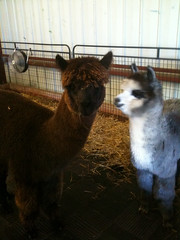
This weekend was a "guild weekend", so my attention was focused on all things crafty: embroidery, knitting, crochet, spinning and weaving. Saturday, I learned a few smocking basics. Sunday included a quick trip to an alpaca event "on the way" to my tapestry weaving get-together.

alpacas!

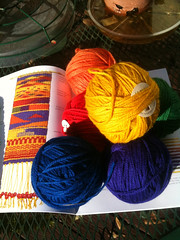
I have been thinking about using a tapestry design instead of my freeform attempt last time. While I loved doing the freeform project, I really want to focus on technique. So I decided to do a sampler from Kristen Glasbrook's Tapestry Weaving. Yarn is bought and I am ready to go!

tapestry

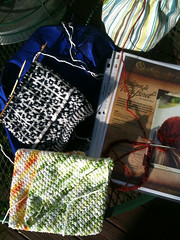
And last but not least, here my knitting/crochet projects as of today. From top left, my steeking class project (homework completed!), Autumn Vines Beret from Never Not Knitting, and two potholders for my grandmother.

in progress 2-15-11

Needless to say, house projects have come to a standstill. I really need to get those back underway - christmas is still in my living room and I also want to do another cull of the stash.

Someday....

Labels: , ,


Monday, August 11, 2008
Diary of a Weaving Project, Part 2
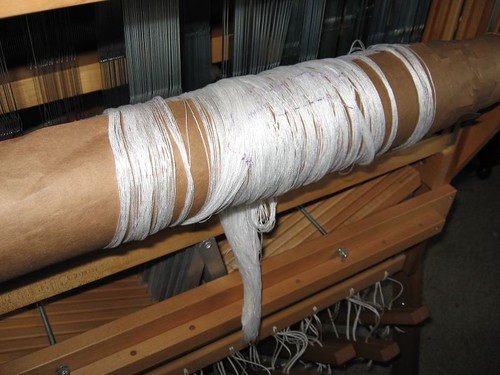
So here we are with our project on the back beam.

IMG_0177

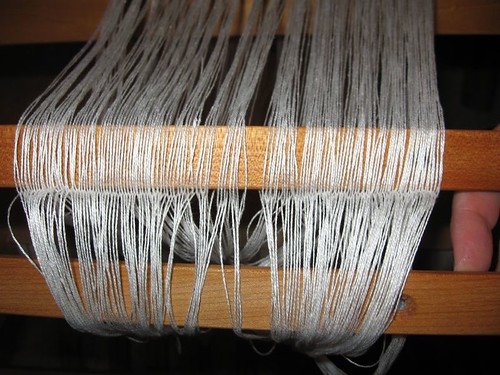
The warp was constructed with a cross, which helps keep the threads in order. The cross is held on the warping board by ties, but once on the loom, lease sticks are used to keep the cross open.

IMG_0181

After the lease sticks are inserted, they are tied up so they hang one above the other.

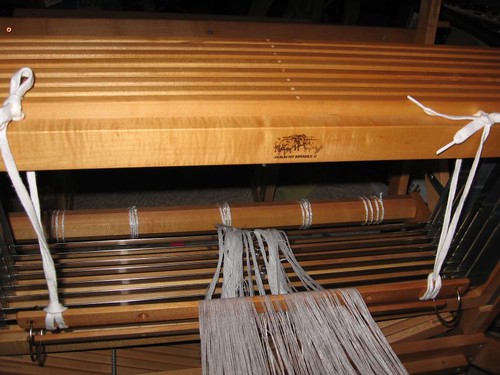
IMG_0182

What you see above is the view from the back of the loom; the warp comes up from around the back beam, through the lease sticks, and in between the harnesses on the loom. My baby wolf is an eight harness loom, which means that there are 8 frames that lift the warp threads up and down. On each frame, there are heddles, made of metal (such as on my baby wolf) or of polyester cord.

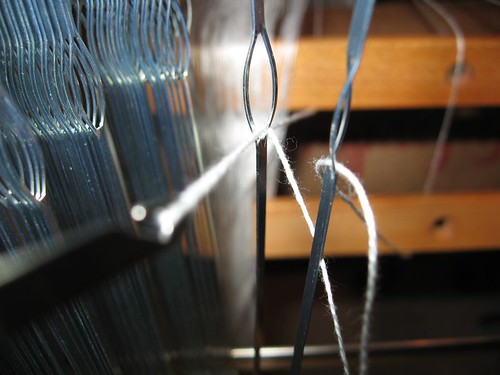
I selected a point twill threading, which means that I will need a heddle on harness 1, then a heddle on harness 2, then harness 3, and so on up to harness 8. Then harness 7, harness 6, and so on through harness 2. That threading will continue all the way across.

IMG_0184

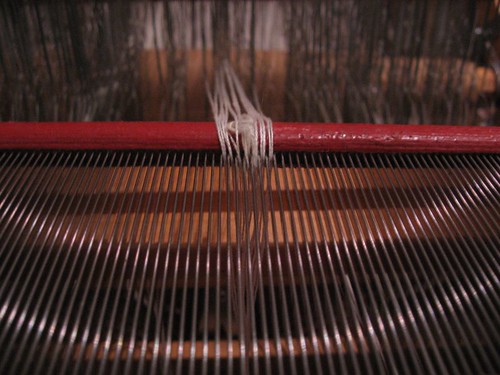
This is done with a heddle hook! After all of the heddles are threaded, it is time to sley the reed!!! I set up sticks to allow me to lay the reed down flat, which is easier for me to work with than if it is upright in the beater. If you remember in the first post, I decided to thread the warp 24 ends per inch. So I'm using my 12-dent reed (which means 12 slots/dents per inch) and thread 2 ends in each dent.

IMG_0198

Next up, tying the warp to the front beam and tying up the harnesses!

Labels:


Sunday, August 10, 2008
Diary of a Weaving Project, Part 1
A couple of weaving projects have been on my mind the last couple of weeks. I set my project plans on hold though, when I realized I had only unthreaded my mistake-ridden warp was still on the loom. I think there are about 10 yards left on it, so I decided that it would make the perfect project to try to answer a friend's question of how long it would take to make a dishcloth.

I really couldn't answer her question because weaving one would not be cost effective to me and mainly because I drag my set up time out. In my experience, weaving is pretty much the opposite of knitting:

Knitting = small set up, lots of actual knitting.
Weaving = lots of set up, less time actually weaving.

So I thought I would try to break it down. Since I'm using a project already on the back beam of the loom, I have no pictures for this post, but will add them as I can.

OK, my post reads a little strange, so I'm editing to try to clarify. Hopefully I don't make it worse!!! First the technique, then the process!

Weaving is defined by wikipedia as a textile art in which two distinct sets of threads (called the warp and weft) are interlaced with each other to form a fabric or cloth. The warp threads run lengthways of the piece of cloth, and the weft runs across from side to side.

A loom can be used to control the warp threads, by keeping them parallel and in order, the warp is stored on the loom on the warp beam.

To keep the warp threads in order and parallel, they are threaded through things called heddles. These heddles are contained in harnesses or shafts.

To make cloth, a harness (or harnesses) are lifted as the weft is placed (usually with a shuttle of some kind) between the lifted threads and the nonlifted threads. The lifting of harnesses can be controlled by foot treadles (on a floor loom) or by levers at the top or side of the loom(for a table loom). Looms can have two or more harnesses (that's another discussion!).

Spacing of the weft threads is determined by "beating" the weft threads to other weft threads, making cloth. In a loom, the beater is comprised of a reed and a mechanism to hold the reed. The reed has slots to space the warp threads. As cloth is created, the warp is advanced, so that the cloth rolls onto the cloth beam.

So, to sum up, the warp runs from the warp beam, through heddles in harnesses, through the reed, to be stored as cloth on the cloth beam.


Planning the warp is the first task - what you want to make, what size you need it to be, and what yarns you want to use. The size of the warp is based on all of those factors. To some degree, you can change what you are going to do after you set up, but not by much.

So let's make a table runner, say 9 inches wide by 6 feet long. The warp itself is not fully usable, as there is a certain amount of warp at the beginning and end that you can't weave on. So I would add on another yard to account for that waste, to require a total of 3 yards for the length. Now it's time to calculate the number of warp threads.

The type of yarn that I am using is 10/2 cotton, which has to be sett at about 24-28 ends per inch. I am going to go with 24 to give it more drape. Adding another inch to the width to assume some kind of shrinkage gives me 10 inches in width. 10 inches x 24 ends per inch = 240 ends, which means I need to wind a warp of 240 ends that is 3 yards long.

Once that is wound, the warp is looped around an apron rod, which is attached to the back beam. The warp has to be spread out before being loaded onto the loom, so I use a thing called a raddle. Once the threads are spread across the raddle, the warp is wound onto the back beam under tension.

Labels:


Thursday, October 11, 2007
The Baby's First Weaving Pics
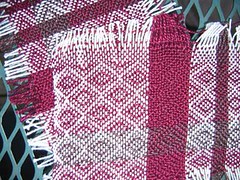
When I got my Baby Wolf, it came with a 10/2 warp on it. I quickly got to work weaving it off. Here are some of the pieces I made:

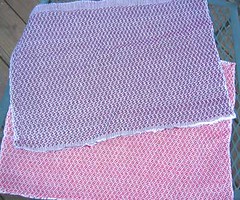
Same treadling with different weight yarns (Red = 10/2, Garnet = 5/2)

reds

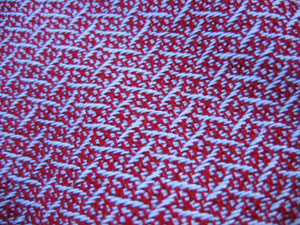
A closer look:

red-close

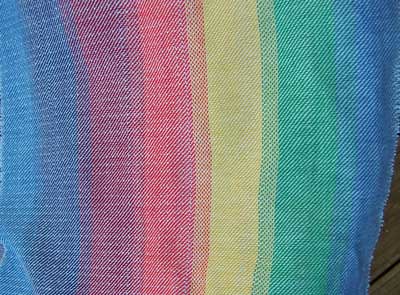
lots of different 10/2 cottons

rainbow

So the loom was empty and I got a little spooked with a 500+ warp in 10/2 as my first warp. I quickly put on a 5/2 warp, with 180 ends and continued to play with different tie ups.

mug-rug

test

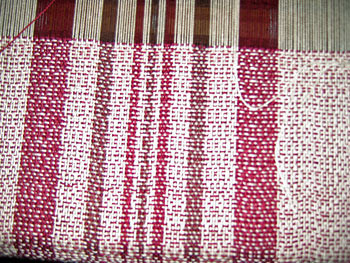
I finally found a tie up that I liked for a possible table runner:

current

Labels:


Weaving Class Pictures
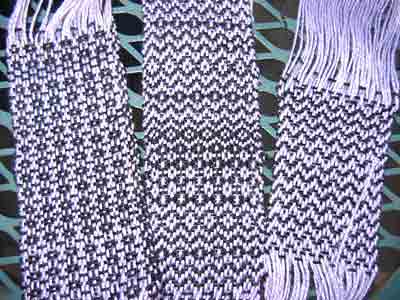
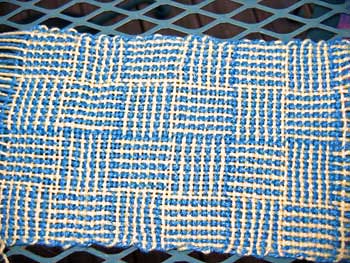
Not a lot of sun by the time I got the camera out, but here are my samples from my Immersion Weaving class I took back in August. All using 5/2 perle cotton.

Twill
sample

Log Cabin
log-cabin

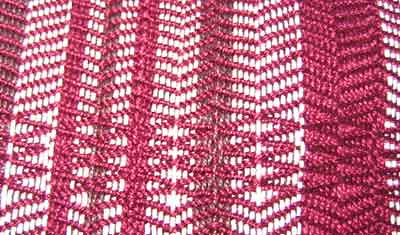
Bronson Lace
bronson

Labels:


footer2.JPG